Friday, 24 February 2012

Musical Cognition


I’ve just finished reading Henkjan Honing’s Musical Cognition:  A Science of Listening.  Although I had low hopes for another book about how we process music, written for the layperson, I found it to be a little gem of a book, with bite-sized, digestible chapters. 

And many of the chapters did require a bit of chewing and digestion.  The book is indeed written for the layperson, eschewing jargon and complicated figures, but that does not mean that Honing assumes (as many authors seem to do) his reader to be uneducated or slow-witted.  On the contrary, Honing allows the reader space to consider and contemplate as he carefully but conversationally guides the reader through such knotty problems as “What is music” and “How do we recognize beat and meter in music?”, referring to his own research and that of others to describe approaches to answering these questions.  I admit that I didn’t always feel like thinking that hard, but it was well worth the effort.

In the end, one of main points of this book is that we are all trained listeners, with a lifetime of experience at listening to music.  The "illiterate" listener, lacking formal musical training, is almost as good at listening to and understanding music as a professional musician, but is not able to put names on all he hears.  What the illiterate listener lacks is mostly musical vocabulary.

Far from being the fluffy read I anticipated, this book was thoughtful and thought-provoking.  I’d love to sit down with Honing and discuss the questions raised in this book over several cups of coffee.

Thursday, 16 February 2012

Music makes us happy


It’s 2:55 on a Monday, and, as usual, I’m standing in the hallway at the elementary school, waiting for the 3:00 bell to ring and the children to come pouring out of their classrooms.  Another mom stops to chat with me, and says, with no preamble, “Okay, what would you say are the top three benefits to studying music?”  The subtext here is clearly: Is all this effort worthwhile?, a thought that is common to parents of young children studying music, and one I'm definitely familiar with.  Because it really is a lot of work for parents to encourage, motivate, schedule and nag their children to practice every day.

As I said last week, I really feel the number one reason to study music is for the joy of it, but it’s clear that not every second of practicing will bring you joy.  In fact, many of the minutes of practicing are just hard work, and not pleasurable at all, especially for young children who don’t really see that there is a worthwhile goal far down the road from all this effort.  One of the jobs of the teacher and parent, of course, is to try to bring the goals closer and give children some satisfaction from small accomplishments.

Music Improves Mood
But it made me think:  Is there any real scientific evidence to show that music makes you happy?  Well, happiness is kind of difficult to measure scientifically, isn’t it?  There are some standard questionnaires that can be given to people to assess mood, and, using these, it has been shown that singing (either in a choir or individually) improves people’s mood.  In addition, just listening to music can improve your mood, and has been shown to activate the pleasure centres of the brain.  Music therapy has been shown to improve mood in patients with dementia, stroke, cancer, traumatic brain injury, and depression.  So clearly, yes:  music makes people happy.

Physiological Effects of Music
There is also a body of research showing that music (either making it or listening to it) can cause physiological changes in our bodies, such as decreasing stress levels, causing our blood vessels to dilate, boosting our immune response, and acting to reduce our pain perception.  The majority of this research has been performed simply by having people listen to joyful or relaxing music, and doing before-and-after measurements of things like saliva cortisol levels (to measure stress), or saliva immunoglobulin levels (to measure immune response).

The Autonomic Nervous System
How does music entering our ears manage to affect our body?  It kind of sounds like hippie mumbo-jumbo, but there is a good anatomical explanation.  A lot of our bodily functions are looked after by the autonomic nervous system (ANS).  The ANS is made up of nerves that talk to our internal organs --  heart, lungs, glands, blood vessels, etc.  The main role of the ANS is keep all our bodily functions chugging along at a relatively even keel, so that if, for example, our heart rate starts getting too fast, the ANS will try to slow it back down to the right speed.  But what sets what the “right speed” is?  That’s the job of the hypothalamus, a part of the brain that is the master control centre for the ANS.  It uses input from the body and from the other parts of the brain to decide exactly what all our organs should be doing.  The hypothalamus has direct connections with the emotional parts of our brains, so if we’re happy, that affects how our body functions.

Does musical training make you happier?
If all these benefits can be had simply by listening to music, is there extra benefit to performing the music?  Is all this musical training worth it?  I certainly think so, but what does the research say?  I was surprised to find very little research on whether musical training increases overall happiness, but as I mentioned, happiness is something that’s tricky to study. 

Here’s what I did find:  a recent study conducted in Thailand showed that students with musical training had much lower levels of stress hormones right before a stressful math exam than students without musical training.  The researchers concluded that musicians were more emotionally stable.

Another study compared professional vs. amateur musicians and investigated whether they reported having “peak experiences”, defined as “experiences of ego transcendence, glimpses of higher consciousness lying beyond ordinary daily experience”.  The study found that professional musicians were more likely than amateurs to report having these transcendent experiences, and that performing music caused these moments, in both professionals and amateurs.  I can certainly relate, and I'd be curious to know how non-musicians would compare with these two groups of musicians.

Despite the lack of research, I would argue that people with musical training are more likely to listen to music and more likely to be made happy by listening to music.  Simply put, being a musician brings more music into your life. And the satisfaction of making music yourself cannot be denied.  I keep getting sidetracked to the piano today because all this talk of how enjoyable music is makes me just want to go and play music.

Oh, yes...
And the second and third of the top three benefits of music training?  I would say they are the improvements to executive function and to verbal skills, which I really will get around to blogging about one of these days.

References:
  • Beck RJ, Cesario TC, Yousefi A, Enamoto H. (2000). Choral singing, performance perception, and immune system changes in salivary immunoglobulin A and cortisol.  Music Percept. 18:87-106.
  • Bernatzky G, Presch M, Anderson M, Panksepp J. (2011). Emotional foundations of music as a non-pharmacological pain management tool in modern medicine. Neurosci Biobehav Rev. 35(9):1989-1999. 
  • Grape C, Sandgren M, Hansson L-O, Ericson M, Theorell T. (2003). Does singing promote well-being?: An empirical study of professional and amateur singers during a singing lesson. Integr Physiol Behav Sci. 38(1):65-74.
  • Khalfa S, Bella SD, Roy M, Peretz I, Lupien SJ. (2003). Effects of relaxing music on salivary cortisol level after psychological stress. Ann. N. Y. Acad. Sci. 999:374-376. 
  • Kreutz G, Bongard S, Rohrmann S, Hodapp V, Grebe D. (2004). Effects of choir singing or listening on secretory immunoglobulin A, cortisol, and emotional state. J Behav Med. 27(6):623-635.
  • Laohawattanakun J, Chearskul S, Dumrongphol H, et al. (2011). Influence of music training on academic examination-induced stress in Thai adolescents. Neurosci. Lett. 487(3):310-312. 
  • Menon V, Levitin DJ. (2005). The rewards of music listening: Response and physiological connectivity of the mesolimbic system. NeuroImage. 28(1):175-184.  
  • Miller M, Mangano CC, Beach V, Kop WJ, Vogel RA. (2010). Divergent effects of joyful and anxiety-provoking music on endothelial vasoreactivity. Psychosom Med. 72(4):354-356.
  • Travis F, Harung HS, Lagrosen Y. (2011). Moral development, executive functioning, peak experiences and brain patterns in professional and amateur classical musicians: Interpreted in light of a Unified Theory of Performance. Consciousness and Cognition. 20(4):1256-1264. 

Thursday, 9 February 2012

Music Training and IQ


No one doubts it: Parents have a hard job.  In addition to all the day-to-day cooking, cleaning, cajoling, and ferrying kids about, parents have to make big decisions about what’s best for their child.  We all want our kids to be well-adjusted, happy, and living up to their potential.  And one of the trickier minefields to maneuver through is the choice of extra-curricular activities.  Dance, swimming, drama, a multitude of team sports, martial arts, chess club, scouts, Mandarin class, gymnastics, the list goes on.  Oh, and did I mention music?  The parent has to weigh out the time involved, the child’s eagerness to participate, and the potential benefits to the child.

Does music training make you smarter?
Which is, of course, where I’m going with this.  It’s hard to nail down all the benefits of musical training, but one that keeps coming up again and again is the idea that musical study makes people smarter.  But does it?  A few weeks back I advised you to take research about music and IQ with a grain of salt.  Ask around, and you’ll hear that people who study music are smarter overall than people who don’t, and the common assumption is that the musical training itself contributes to the increase in IQ.  But the causation could run the other way too:  people who are smarter are more likely to take and stick with music lessons.  The basic question is this:  Does studying music make people smarter OR do people study music because they are smarter already?

The only way to really test this question is by a longitudinal study, where people are randomly assigned to either receive music lessons or not, and the effects on IQ are studied.  In the last decade, there have been a couple of good studies that have investigated this question.

Figure from Schellenberg (2004).

Music training leads to a greater increase in IQ
The first, a study by Glenn Schellenberg at the University of Toronto was published in 2004.  In this study, 6-year-old children were placed into four different groups:  piano classes, voice classes, drama classes, or no classes.  The children were given IQ tests at the beginning of the study, and at the end, after 36 weeks of classes.  All groups showed an increase in IQ, which is expected, because they were 9-10 months older, and had been attending school during that time.  But here’s the key result:  children taking music (piano or voice) classes had a slightly larger increase in overall IQ compared to control or drama students.  The researchers made sure there were no overall differences in the parent’s socio-economic status between the four groups, and included the drama class control group to prove that it was specifically music and not extracurricular activities in general that improved IQ.

Music training causes structural brain changes
In 2009, a similar study was published by a group of scientists in Boston. In this study, there were only two groups:  one group received 15 months of keyboard lessons, and the second group received no lessons.  The children were given a set of behavioural and IQ tests before and after the 15 months and it was found that keyboard training increases performance on finger fine-motor tasks and melodic and rhythm discrimination tasks.  However, this study found that there were no significant differences in IQ between the two groups of children.  This result may be due to the small number of children in this study.  Only 31 children were studied, compared to 144 in the Schellenberg study.  When the differences to be observed are small, a large number of test subjects is required.

The Boston researchers went one step further and performed MRI brain scans of the children before and after the 15 months of training.  Amazingly, they were able to show that musical training causes structural changes in children’s brains.  Children who had 15 months of keyboard lessons had more growth in the following areas (compared to children with no music training):
  • The corpus callosum, which connects the two sides of the brain
  • The right primary auditory cortex, which processes sound information
  • The right motor cortex, especially the hand area, which controls the left hand
  • The left and right frontal cortex, involved in working memory and the processing of harmony and tonality
So musical training causes changes in the brain, but for the most part, these changes occur in the places that one would expect, the parts of the brain that are involved in music processing and production.  Does growth in these parts of the brain lead to improvements in overall intelligence?  I would argue that it could, especially growth in the frontal cortex.  As I reported back in November, the frontal cortex is involved in a variety of general-intelligence skills known as “executive functions”, and these have been shown to improve in preschoolers taking music classes.  Increased connectivity between the two sides of the brain through an enlarged corpus callosum could also contribute to improved mental processing.  And a more finely-tuned auditory cortex could allow for improved verbal skills.  In sum, structural changes in the brain caused by musical training could certainly underlie a small increase in general intelligence.

But is this really the main benefit of musical training?
I should reemphasize that this 2009 study did not find any overall increases in IQ.  I think most researchers believe that the enhanced brain growth and rewiring caused by musical training results in an increase in overall intelligence, but the effect is small.  If we only focus on the benefits of musical training on intelligence, I think we are missing the boat.  Music offers so much more than this:  a vehicle for self-expression, training in self-discipline, solace, an opportunity to stand up in front of people and perform, a chance to be really good at something.

Personally, I want my children to study music simply for the joy of making music.  There’s nothing like it.

References:
  • Schellenberg EG.  (2004) Music lessons enhance IQ.  Psychological Science 15(8):511-514.
  • Hyde KL, Lerch J, Norton A, Forgeard M, Winner E, Evans AC, Schlaug G. (2009) Musical training shapes structural brain development.  Journal of Neuroscience 29(10):3019-3025.


Thursday, 2 February 2012

Musical training protects auditory processing speed

 
Neurons in the auditory pathway have the fastest temporal responses of any sensory neurons.  And this makes sense:  visual, tactile, taste and smell stimuli don’t change as quickly as sounds do, so the neurons supporting those senses don’t have to be as fine-tuned in time as those that support hearing.

It has been known for a while that the auditory pathway in older brains doesn’t work as quickly as in younger brains, so that, quite apart from actual hearing loss, older people have a harder time understanding speech because they just can’t listen fast enough to be able to properly register to such high-speed auditory input.

But now a new study has shown that musical training can reduce or eliminate this decrease in neuronal processing speed in the auditory pathway.  The study, conducted in the lab of Nina Kraus at Northwestern University compared brainstem auditory responses to the sound “da” in four groups of people:  younger and older non-musicians, and younger and older musicians.  What they found was revealing:  older non-musicians had much slower responses to the transition between the consonant and the vowel in the sound “da”, compared to younger non-musicians.  In contrast, the auditory responses of older musicians were very similar to those of younger musicians.

 
(Figure from Parbery-Clark, 2012.  Panel A shows the temporal characteristics of the sound “da”, while Panels B and C show the subjects’ brainstem responses to the sound, as measured by EEG)

Musical training therefore acts in a protective fashion to maintain the auditory processing speed of older adults, which undoubtedly helps them to be able to understand speech.  The question now is whether musical training starting later in life can help elderly people regain auditory skills that they have lost.

Reference:
Parbery-Clark A, Anderson S, Hittner E, Kraus N. (2012) Musical experience offsets age-related delays in neural timing.  Neurobiology of Aging in press, doi: 10.1016/j.neurobiolaging.2011.12.015

Thursday, 26 January 2012

Sixth Sense


I’m watching a friend play a Chopin Waltz.  Her eyes are kept trained on the music in front of her, but her left hand is jumping back and forth between the bass notes and the upper notes of each chord.  Her pinkie strikes a low C# and then her hand moves right off the keyboard and, unguided by her eyes, flies up to play a C# minor triad over an octave higher.  Then, in a split second, she leaps her hand down to a low D, again without looking.  How do her fingers land unerringly on the correct notes each time?  To the untrained, this seems like magic, or maybe a sixth sense.

How many senses?
Ask any school child how many senses we have, and you’ll get the answer:  five.  Sight, hearing, taste, smell, and touch.  We’re all taught this, but the answer is correct only up to a certain point.  The reality is that we have five senses that tell us about the outside world, but a number of other senses that tell us about our own body.  The two main internal senses are balance, which tells us about the orientation of our head and body with respect to gravity, and proprioception, which tells us about the positions of our various body parts.

 (Photo credit:  aarrgh via Flickr)

If you’re not convinced that you have a sense called proprioception, try this little demonstration:  Close your eyes.  Now wave your right arm all over the place.  Then touch your nose with your right forefinger.  You didn’t have any trouble finding your nose did you?  Even without looking, your brain knew exactly where in space your finger was, and exactly where your nose was.  It accomplishes this by receiving information from special receptors in your muscles and joints, which tell the brain how much stretch there is on each muscle, how much load there is on the muscle, and what angle the joints are bent at.  From this information, the brain assembles a spatial map of your body so that it knows how to move in order to accomplish a particular movement goal, like touching your nose.

Conscious and unconscious proprioception
Proprioception information from the muscles and joints travels up the spinal cord to two separate places in the brain.  One set of information goes to the somatosensory cortex (which also receives information about touch), and this provides us with conscious awareness of where our body is in space.  An identical set of information travels to the cerebellum, where it is used unconsciously to provide feedback about our movements, and to aid in motor learning.

We don’t think much about our sense of proprioception, but we are using it all the time.  This is especially true of instrumental musicians.  Consider the left hand of my friend, jumping back and forth between the bass note and upper notes of each chord.  An inexperienced (or unpracticed) pianist would need to watch her left hand to make sure she hits the correct notes, but with practice the hand “knows” exactly how far to move to land on the right keys.  This is proprioception in action.  String players similarly have to know exactly how far to move each finger to play the next note.  They don’t have to watch their fingers.  The fingers themselves are sending signals to the brain as to their positions, so we know where our fingers are without watching.  (String players, of course, also use auditory feedback to know where their fingers are, since the position of the finger on the string fine-tunes the pitch of the note)

Practice makes perfect
Like anything else the brain does, proprioception can be improved with practice.  This can start away from the instruments, by having students move particular fingers without looking.  In my beginner MYC classes we always spend time singing finger number songs like “Where is finger one?” and having the children stick up the correct finger as we sing.  After the children know which finger is which, we can try this exercise with eyes closed.  It’s trickier but very useful.

It’s common for young students to use vision instead of proprioception to guide their playing.  A little girl in one of my classes last week had exactly this problem, and had to pause and look down at the keys periodically while performing for me.  Then, as she returned her eyes to the page in front of her, she had to pause again to find her place. I recommended that her mother hold a piece of cardboard over her hands as she practices to force her to use proprioception instead of watching her hands.   

Forcing ourselves to play without looking is an excellent way to improve proprioception.  Once technical exercises are mastered, I recommend that an additional week be spent practicing them with eyes closed.  This can be quite challenging for chords and arpeggios but will pay dividends in the future.

My experience is with piano, but each instrument has its own proprioceptive demands.  For example, I also play the flute, and it’s pretty much impossible to watch your fingers while you’re playing the flute.  Flutists, therefore, are required to rely on proprioception from the very beginning of their training.  I’d love to hear suggestions for improving proprioception on any instrument.


Thursday, 19 January 2012

“Fast” and “Slow” Learning


Every once in a while, I take a step back from working with my students and notice just how far they have come since they started studying piano.  That adorable five-year-old learning to harmonize her scales was (just yesterday, it seems) a chubby three-year-old who struggled to coordinate her fingers to play three different notes in a row.  The focused eight-year-old determined to get the hang of using the sustain pedal used to be an overly-bouncy five-year-old who had a difficult time playing with two hands. Part of their progress is developmental, of course, but mostly it is due to their daily practice and commitment to learning music.

Fast vs. slow learning
When we practice a musical instrument (or other motor skill) over a long period of time, there are actually two types of motor learning going on.  The first is “fast” learning, which happens on a timescale of minutes to days, and is characterized by automatization of specific motor tasks.  This is the learning that we see when a student gets better at playing a particular piece of music.  It is likely due to changes in synaptic strength in particular brain regions. Scientists see a decrease in brain activity as fast learning occurs. 

In contrast “slow” learning occurs over weeks to years and is seen as gradual improvements in performance.  This is the learning that we see over the long-term, when students get better at playing overall, so they’re able to master more difficult repertoire.  It depends on reorganization of areas in the brain, and the recruitment of additional brain regions for certain tasks.

We can illustrate the difference between these two types of learning by comparing a beginner musician with an experienced musician.  Imagine the two musicians are given the same piece of music to learn, a piece of intermediate difficulty.  For the beginner, the piece would be extremely hard to play, because she would not have the basic motor skills needed to perform it.  For the advanced musician, the piece would be less difficult, because she would already have learned “how” to play.  The difference between the two musicians is in the amount of slow learning that they have done.  The experienced musician has motor patterns laid down in her brain that allow her to more-or-less effortlessly convert the written music to movements which cause the correct sounds to be produced.

If both musicians practiced this piece, they would both get better at playing it, through repetition of the specific movements required to play the piece.  This is fast learning.

Brain changes in fast and slow learning
Studies have shown that fast and slow learning involve changes in different parts of the brain.  Susan Landau and Mark D’Esposito at UC Berkeley performed a fascinating study that was published in 2006.  They compared the brains of pianists and non-pianists performing a finger-movement task while undergoing fMRI scans, to see what parts of the brain were being used.  This study looked at slow learning that had already happened in the brains of the pianists, by seeing how their brains were different from non-pianists.  And it also looked at fast learning, by seeing how the brain of each individual changed as the participants improved at the task.

What they found was that the pianists used several areas of the brain that were not used by non-pianists, most notably the caudate nucleus (part of the basal ganglia, thought to be involved in motor planning) and parts of the parietal lobe, which is known to be involved in integration of sensory information, and has been previously shown to be activated during music playing.  During their years of musical training, the pianists have recruited these extra regions of the brain to be used during finger movements.

For fast learning, the study showed that brain activity decreased as participants learned the task.  This was particularly true for activity in the premotor and supplementary motor cortex.  What this means is that our brains have to work hard at a new task.  We can feel this, because new tasks seem effortful.  As we repeat new tasks, the areas of our brain responsible for planning and organizing our movements don’t have to work as hard – some of their burden has been shifted to automatic memory processes.

Memory representations
If we learn new but similar tasks over a period of weeks to years, we learn to use different strategies, involving different parts of our brain.  A lot of this involves “chunking” – grouping thoughts or movements into chunks.  For example, instead of  playing a C and an E and a G, we just play a C triad.  Our brain thinks of it as one entity instead of three separate notes, and this representation is much more efficient.  There’s also a motor representation of this: when I think of a C triad, I can imagine playing it and it’s a one-step hand movement.  My brain has a motor pattern already set up to play a C triad, and this uses a lot less brain power than reading each note separately and converting it into movements of each finger.

Teachers guide slow learning
Students (especially children) tend to focus on fast learning:  they just want to get better at playing each particular song.  They realize that their playing is improving generally, but they are not thinking about what path their slow learning should take.  This is what I, as a teacher, need to be aware of:  where is their slow learning taking them?  The teacher’s role is to guide the student's overall motor development.  A given student might need to practice playing in a particular key, or using four-note chords, or playing lots of octaves, so that these hand positions and characteristic movements will become part of their repertoire of motor patterns.

My students are gradually learning motor strategies and memory representations for musical paradigms, and this slow learning is what is turning them into better pianists.

Thursday, 12 January 2012

Earworms: What Makes a Tune Sticky?

 (ear photo by jemsweb, worm photo by daz smith; from Flickr Creative Commons)

Last weekend I had the pleasure of attending a reading of an amazing new musical, One plus One, written by my friends Gil and Sarah Jaysmith.  The music from this show has been bouncing around in my head ever since.  You’ve certainly had this experience:  a fragment of a tune “stuck in your head”, looping over and over.  It seems the only possible way to shake this experience is to replace the tune with another, and even that’s only successful some of the time.  We call these tunes “earworms” and music that tends to get caught as earworms is known as “sticky”.

But are there really characteristics of music that make it more or less sticky, more or less likely to be an earworm?  There is not a lot of research yet about earworms, but it’s starting to crop up in journals about the psychology of music, so I had a quick look to see what’s known.

To start with, scientists tend to call this phenomenon “Involuntary Musical Imagery”, INMI for short.  It’s kind of hard to study something that can only be based on people’s verbal reports of its existence, so the studies that are out there all use the technique of simply asking people about their earworm experience.  And the studies have shown something you may have guessed:  earworms are very common. Over 90% of people reported that they experience earworms at least once a week.  About 60% have them at least once a day, and 26% of people have them more than once a day (these numbers are from Liikkanen, 2008).
                    
Recent vs. Sticky
Another interesting study from Finland looked at whether there was a recency effect in earworms.  The recency effect is a well-known memory characteristic, in which we’re more likely to remember the last item in a list, rather than an item in the middle, because we’ve seen it more recently and also, no other items have been introduced to interfere with the memory.  In this 2009 study, Liikkanen proposed that tunes that we’ve heard most recently are most likely to be stuck in our head.  This makes sense to me based on my own experiences:  I’ve often had an old pop song stuck in my head and wondered, “Where did that come from?”, but when I thought a little, I remembered that that song had been playing in the grocery store I had visited 10 minutes earlier.  I hadn’t even really noticed the song when it was playing, but just hearing it caused it to be stuck in my head almost right away.

Liikkanen performed an internet study using thousands of Finnish internet users, and he triggered earworms by having the particpants complete lyrics to a number of songs.  The order in which the songs were presented was varied, so that Liikkanen could test whether the song presented last was more likely to trigger an earworm.  After completing the lyrics, the participants did a “filler” exercise for four minutes, and then they were asked if they had experienced any earworms.  About 50% had, and the results showed two things.  First of all, some songs were just more “sticky” than others, no matter what order they were presented in.  But also, the song presented last was more likely to get stuck in the participants’ heads.  So yes, there’s a recency effect.  But the characteristics of the songs themselves also have an effect on whether they’re likely to get stuck in your head. 

On the other hand, a diary study by Beaman and Williams (2010), in which 12 people reported in detail on over 250 earworm episodes, found that only 10 different tunes were experienced as earworms by more than one person.  You’d think that if certain tunes were intrinsically very sticky, then these tunes would get stuck in everyone’s head, especially if they were current pop hits or TV themes, or current advertising jingles.
  
Circumstances
The most recent paper on the topic of earworms, by Williamson and colleagues, looked at the circumstances under which they occur, and amassed a large pool of earworm data from internet users.  The researchers were trying to answer the question:  “Under what circumstances do earworms occur?”, and their results were interesting.  The most common circumstance in which a song got stuck in someone’s head was when it had been heard recently, or heard repeatedly.  This jibes with Liikkanen’s 2009 study.

Another common circumstance that triggered an earworm was through association – for example, seeing a picture of Elvis might trigger Blue Suede Shoes, or remembering a high school dance might start Stairway to Heaven playing in your head.  Obviously these associations are highly individual.  Mood plays a factor too, since certain moods like sadness or stress can trigger certain melodies for some people.  In fact, just thinking of whether sadness triggers any melodies for me brought into my head the song I’m so lonesome I could cry, as performed by Holly Cole.

Another experience that was identified as leading to earworms was boredom, when the mind starts to wander.  And this I find particularly interesting because I think this is a clue to what parts of the brain might be involved in generating earworms.

The Default-Mode Network
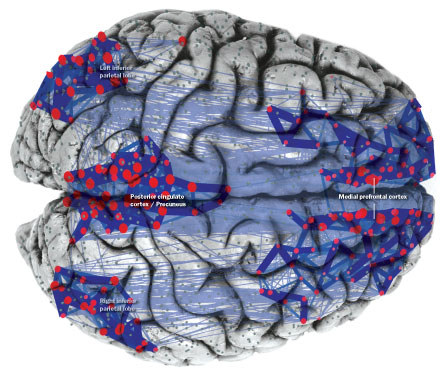
In general music imagery activates the same parts of the brain that are activated when we listen to music.  If you imagine hearing a song, it actually activates the auditory cortex just as if you were hearing it.  However, involuntary music imagery is probably slightly different, because it tends to occur when we’re not actively thinking about the music.  There’s actually a brain network that’s activated when we’re not consciously thinking about anything: the default-mode network, which consists of the medial prefrontal cortex, precuneus, posterior cingulate cortex, inferior parietal cortex, and lateral temporal cortex.

Figure from Buckner et al., 2008


Activity in the neurons in this network goes down when we’re thinking about something, and increases when we’re doing nothing.  Activity in the default-mode network is believed to be the neural correlate of mind-wandering.  There hasn’t been any research on this yet, but I’d be willing to bet money that your default mode network is active when you’ve got an earworm.

Characteristics of Sticky Songs?
The research on earworms certainly is a start, but I was surprised that I couldn’t find any research that looked at musical characteristics of songs to try to determine what would make a song “sticky” or not.  There is a lot of speculation about it, but nothing even close to conclusive. 

Here’s my own take on earworms:  I have music stuck in my head pretty much all the time, except for when there’s music actually playing, or if I’m busy teaching, talking, or thinking about something.  In other words, if my mental effort is directed somewhere, no earworms, at least not that I’m aware of.  If I’m doing something that doesn’t require my conscious thoughts, then there’s an internal soundtrack, usually a repeated fragment of a song.  What this means is that the earworms are generated when my default mode network is active:  when I’m cooking meals or washing dishes, during my 30 minute bike ride to pick up the kids from school, when I’m waiting for a bus, when I’m lying in bed trying to get to sleep.

The default mode network seems to be responsible for working through background thoughts, making connections, making sense of stuff that’s happened recently.  And what’s happened to me recently?  Well, lots of music.  The music that gets stuck in my head the most is music that I’m trying to learn, or trying to make sense of:  songs from a new musical I’ve heard, for example.  In the last few days, when my earworms haven’t been Jaysmith earworms, my mind’s ear has been working away at the “Mah na Mah na” song from the Muppets.  I’ve been teaching this song to my students with the ambitious plan that they will sing it as a combined group at their upcoming piano recital.  I still haven’t quite figured out the best way to teach them the rhythms, which are a little complicated, and I also haven’t figured out who will sing which bits, and whether the verses will be improvised scat or sung as written.  I’ve also been practicing the piano accompaniment.  With all this focus on the song, it’s not at all surprising that it’s the one stuck in my head:  I’ve heard it lots recently, and also my conscious mind has several problems to solve with respect to it.

The research on earworms is admittedly pretty limited so far, but a lot of it points to the idea that earworms are all about memory:  the tunes that turn into earworms for us are those that are important, heard recently, heard repeatedly, or are triggered by an association with something else.  None of this has much to do with the characteristics of the music itself, but anecdotally we certainly find that some music is “stickier” than others.  I think this is simply because some music is more memorable than others.  Sticky music is tuneful, entertaining, accessible without being predictable, and contains repetition of the themes to help you remember it.  The Jaysmith’s music easily has these characteristics, and it’s not surprising that it has a strong tendency for earworm formation.

Memorable music gets remembered, and our default-mode network has us thinking about it when we’re not doing other things.  The really interesting question about earworms is why we can’t stop them.  Some people have related them to obsessive-compulsive disorder (OCD), in which people have thoughts that they are unable to stop.  But no one has shown a relationship between OCD and earworms, so it’s completely unclear whether there is any neurological similarity.  Why can’t we stop these bits of tunes from bouncing around in our heads?  No one knows.  I guess the researchers still have some work to do. 


References:

  • Beaman CP, Williams TI. Earworms (stuck song syndrome): Towards a natural history of intrusive thoughts. British Journal of Psychology. 2010;101(4):637-653.
  • Liikkanen LA. How the mind is easily hooked on musical imagery. Proceedings of the 7th Triennial Conference of European Socity for the Cognitive Sciences of Music. 2009.
  • Liikkanen LA.  Music in Everymind:  Commonality of Involuntary Musical Imagery.  Proceedings of the 10th International Conference on Music Perception and Cognition. 2008
  • Schürmann M, Raij T, Fujiki N, Hari R. Mind’s Ear in a Musician: Where and When in the Brain. NeuroImage. 2002;16(2):434-440.
  • Williamson VJ, Jilka SR, Fry J, et al. How do “earworms” start? Classifying the everyday circumstances of Involuntary Musical Imagery. Psychology of Music. 2011. Available at: http://pom.sagepub.com/cgi/doi/10.1177/0305735611418553. Accessed January 12, 2012.